
SEO Title : Auditory Processing Disorder Racial Disparities: 5 Proven Reasons Black Families Are Overlooked
META DESCRIPTION: Auditory processing disorder racial disparities leave Black children mislabeled and undiagnosed. Learn why the gap exists and what equitable APD care looks like.
By Dr. Skyler Joseph, Au.D. | EarSay Audiological Services
Introduction
Auditory processing disorder racial disparities are real — and if you’ve ever wondered why it’s so hard to get an APD evaluation for your child or for yourself, you’re not imagining it. Access to APD care has never been equally distributed. And for Black and Brown families, the barriers go deeper than scheduling and insurance.
This post is about that gap. Where it comes from. Why it persists. And what it means for the work we do at EarSay.
How Auditory Processing Disorder Racial Disparities Show Up in the Data
A cross-sectional study published in the American Journal of Audiology looked at children referred for APD evaluations at a major audiology clinic. The findings were shocking. Of all the children referred, 85.6% were white. Black children made up only 5.8% of referrals — far below their share of the overall population. Research published in PMC confirms that Black and Hispanic children are significantly underrepresented in APD referrals, and that the actual number of children who needed evaluations was almost certainly much higher.
That’s not a coincidence. It reflects something systemic. Auditory processing disorder racial disparities in referral rates mean that Black children who need evaluation are simply not getting in the door.
When APD Looks Like a Behavior Problem
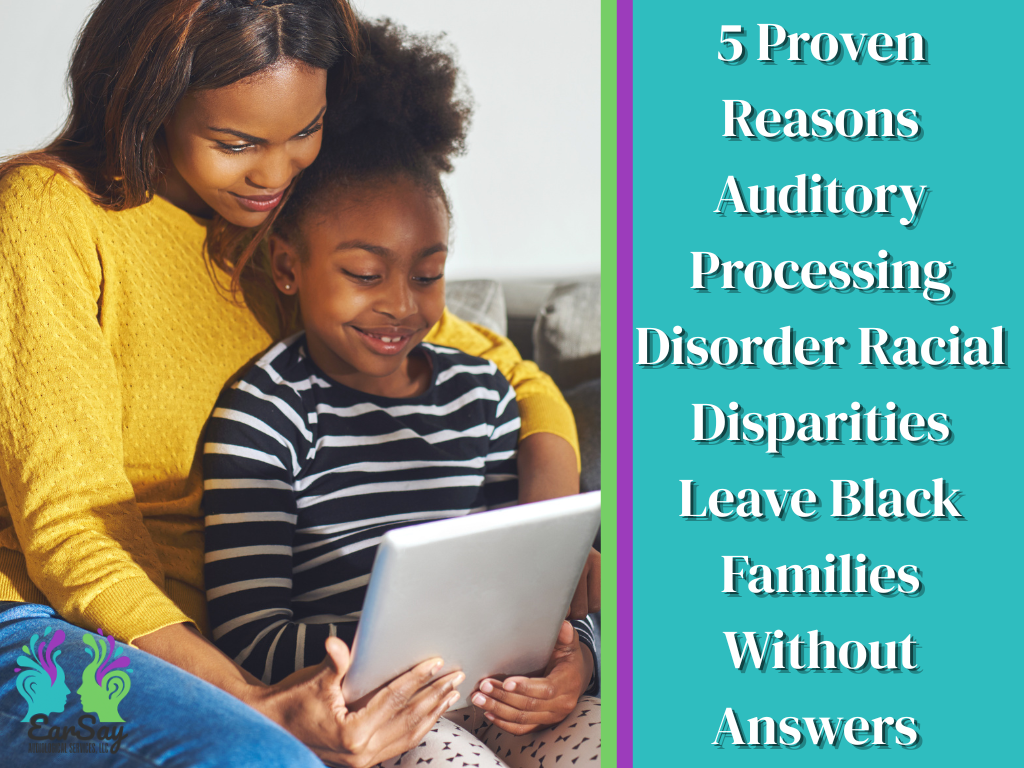
Here’s what happens too often: a Black child is struggling to follow directions in the classroom. They seem distracted, reactive, or “difficult.” Teachers flag the behavior. Parents are called in. And somewhere along the way, the child gets labeled — not evaluated.
The brain-ear connection is rarely explored. No one considers that the child might be working twice as hard as their peers just to decode what’s being said in a noisy room.
Research on racial disparities in neurodevelopmental diagnosis shows that Black children are more likely to receive conduct disorder diagnoses than their white peers, while ADHD and learning-related diagnoses — which can overlap with APD symptoms — are applied inconsistently across racial groups. Implicit bias in the diagnostic process plays a real role in those outcomes.
When a listening difficulty gets mislabeled as a behavior problem, children don’t get the right help. They lose years, and the families doing everything right still hit a wall.
The FindABlackDoctor.com Lawsuit and What It Signals
In May 2026, a federal lawsuit was filed against FindABlackDoctor.com — a directory founded to help Black patients connect with Black physicians. The lawsuit, brought by a conservative advocacy group called Do No Harm, argues that limiting the directory to Black providers constitutes racial discrimination.
The platform was built in response to a documented reality: Black patients report higher rates of medical mistrust, lower rates of feeling heard by providers, and worse health outcomes across nearly every specialty. Research consistently links those disparities to lack of access to culturally competent care.
Whether or not the lawsuit succeeds, it signals something every healthcare provider needs to take seriously. The systems Black communities have built to navigate a healthcare landscape that wasn’t designed for them are now under direct legal pressure. That pressure makes the work of culturally competent care more important, not less.
What Culturally Competent Audiology Actually Means
Cultural competency isn’t a checkbox. It’s not a line on a website.
It means understanding that some families have been burned by the healthcare system and approach appointments with caution — for good reason. It means knowing that “difficult behavior” in a classroom can look very different depending on who’s doing the observing. It means asking about a child’s home language, their classroom environment, and their full history before drawing any conclusions.
It means not assuming.
At EarSay, culturally competent care is woven into how we practice — how we communicate, how we evaluate, and how we build care plans. The Buffalo Model gives us a framework that’s thorough and individualized. But the relationship we build with each family is what makes that framework actually work.
Who Auditory Processing Disorder Racial Disparities Hurt Most
APD doesn’t discriminate. It shows up in children of every background, in adults, and in people experiencing hormonal changes later in life. But access to APD care absolutely does discriminate — and Black and Brown families bear the heaviest burden of that inequity.
Children who are being written off as behavior problems when what they actually need is a thorough evaluation of how their brain processes sound.
Adults who spent years being told they just needed to “pay more attention” — and who are only now finding language for what they’ve experienced their whole lives.
Perimenopausal and menopausal women whose listening difficulties are dismissed as stress or cognitive decline, when APD is a real and treatable factor.
All of these people deserve care that sees them clearly.
What EarSay Is Doing About It
EarSay was built specifically to serve people who have been underserved by traditional audiology.
We offer telehealth APD evaluations and therapy for clients in Florida, Ohio, Georgia, and North Carolina. We use the Buffalo Model of APD assessment — one of the most comprehensive frameworks in the field — developed by Dr. Jack Katz.
And we practice audiology with the understanding that your history, your community, and your lived experience matter to getting the evaluation right. Learn more about our APD evaluation and therapy services.
You Deserve a Thorough Evaluation
If you’ve been told your child is “just being difficult” or that you need to “focus better” — and something still feels off — trust that instinct.
Stronger listening starts here. And so does equitable care.
Book your free 1-hour consultation at earsayaudiology.com. We’ll talk through your history, answer your questions, and help you figure out the right next step.
EarSay Audiological Services provides telehealth APD evaluation and therapy for children and adults in Florida, Ohio, Georgia, and North Carolina. Dr. Skyler Joseph, Au.D. specializes in the Buffalo Model of APD assessment and treatment.