


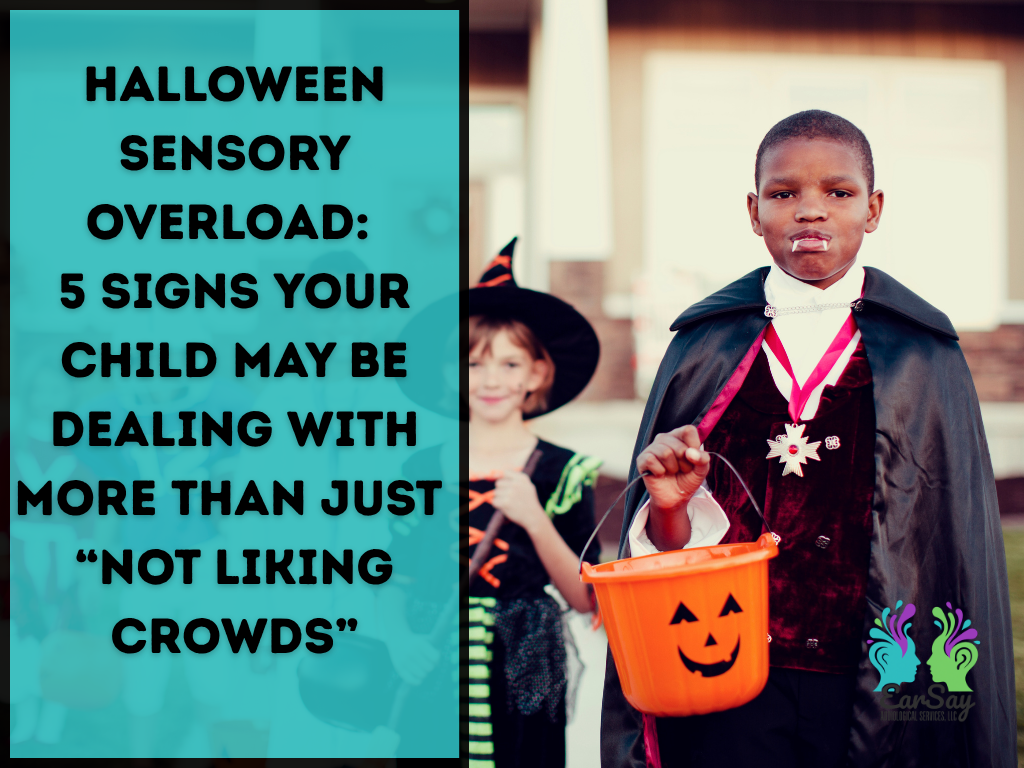
Halloween sensory overload is real, and it doesn’t always start on Halloween. Here’s a story about it that actually starts a few months earlier, at a birthday party.
A birthday party that ended early
A few months ago, we were at a birthday party. Loud music, a bounce house, close to forty kids, cake, the whole nine yards. About twenty minutes in, our twelve year old daughter was clearly overwhelmed. Initially, she asked for her ear buds, then she started asking, over and over, if we could step outside for a break. We took a few breaks, but it wasn’t enough and we eventually ended up having to leave the party early.
I wish I could say that this surprised me, but it didn’t. My daughter has ADHD along with auditory processing disorder, and I have watched this scene play out at more birthday parties, school assemblies, and family gatherings than I can count. She’s usually the first one ready to go, and she almost ALWAYS needs recovery time afterwards. Sometimes the rest of the day.
I’m an audiologist and I evaluate children that deal with these exact difficulties. And even so, I still felt a mix of worry and helplessness, watching my own child hit her limit in a room full of noise that I could not turn down for her.
Here’s what I’ve learned, both from the clinic and from raising her: what looked from the outside like a kid who “didn’t want to be here” was actually a kid whose brain was working overtime just to stay in that room as long as she could..
With Halloween coming up, I’ve been thinking about her again, because trick-or-treating asks for exactly this kind of sustained, layered sound tolerance that’s hardest for a child like mine.
Things like doorbells ringing back to back, other kids screaming and laughing. The possibility of dogs barking behind fences, someone’s Halloween playlist blasting from a driveway, and a crowd of costumes moving down the sidewalk in the dark. For most kids, that’s the fun part, but for kids like mine, all of that noise at once can turn into real Halloween sensory overload. It can come out looking like a meltdown, a shutdown, or a flat out “I don’t want to go”. Totally different attitude from how excited they were about their costume a week ago.
Why Halloween hits differently for some kids
Halloween asks a lot of a children’s ears and brain at the same time. It’s not just loud, it’s loud from every direction all at once, layered with voices, music, sound effects, and no quiet moment to recharge. For a child who has trouble filtering out background noise or picking one voice out of a crowd, that combination can cause a real sensory overload. It has nothing to do with how brave or social they are.
In my daughter’s case, it’s not that she doesn’t want to be there. It’s that her brain runs out of room to keep sorting it all out, and once that happens, there is no talking her out of leaving.
This isn’t the same as just not liking loud things. Kids with a listening or auditory processing difficulty often have a harder time sorting through competing sound specifically, not sound in general. A quiet one-on-one conversation might be fine. A hallway between classes, a birthday party, or a street full of trick-or-treaters is a different story.
5 signs it might be more than a rough night
Every child has an off night, but if you notice a pattern, not just on Halloween, but in other loud, crowded, or unpredictable settings, it’s worth taking note. They’re the same patterns I see in my own daughter, and in the children I evaluate.
- Covering ears or asking to leave once the noise picks up, even for things they were looking forward to
- Seeming fine at first, then falling apart after 20 or 30 minutes in a noisy environment, like they hit a wall
- Getting unusually clingy, silly, or shutting down in group settings, more than what you’d expect from the situation
- Trouble following you or a sibling’s voice once there’s music, other kids, or general chatter mixed in
- Needing a full day, or more, to recover after a loud event, even if they had fun
The one that hits hardest in our house is the second one. Twenty or thirty minutes at a noisy event and she’s done. She needs real time to recover afterward and not just a few quiet minutes in the car. None of these on their own point to anything specific, but if this sounds like a pattern you’ve noticed before, not just around Halloween, it might be worth a closer look.
It’s easy to write off as “just sensitive” or “just shy”
A child that struggles in loud, chaotic settings gets labeled a lot of things; sensitive, shy, dramatic, or not a team player. I’ve heard people say some version of all of this about my own daughter, and as her mom, it stings every time. As a clinician, I know what’s actually happening in those moments, and it’s not a bad attitude.
Sometimes a kid genuinely would just rather skip all the chaos, and there’s nothing wrong with that. Sometimes what looks like a personality trait is actually a kid working super hard to process their thoughts in a room that’s difficult for their brain to sort through.
A large study of more than 1,400 children found that listening and communication struggles were closely tied to attention and overall cognitive load (see Moore et al., Pediatrics, 2010). That’s partly why loud, overstimulating situations, like a street full of costumes, candy requests, and overlapping voices, can wear a child out. It’s not an overreaction. It’s the brain doing a lot of extra work to keep up.
What this has to do with a hearing test
Here’s the part a lot of parents don’t expect: a normal hearing test does not rule any of this out. Hearing happens at the ear level. Sorting through competing sounds and tuning out what does or doesn’t matter, happens in the brain. A child can hear a whisper across a quiet room and still struggle when other things are competing for their attention.
That gap is what an auditory processing evaluation actually looks into. It’s not about volume. It’s about how a child’s brain handles sound once it has reached the ear.
A checkpoint, not a verdict
One rough Halloween doesn’t mean anything on its own. But if this is part of a bigger pattern for things such as, birthday parties, assemblies, the cafeteria, or family gatherings, it’s worth paying attention to instead of chalking it up to a personality trait.
Being my daughter’s mom has sharpened how I practice, but it’s also worked the other way around as well. Raising a child who is both ADHD and APD has helped me recognize some of my own neurodivergent traits along the way. It’s allowed me to provide grace with every family who reaches out to me.
It’s also worth knowing this evaluation doesn’t require an in-person visit. At EarSay, evaluations and therapy are done entirely through telehealth, using the Buffalo Model approach, for families in Florida, Ohio, Georgia, and North Carolina.
I evaluate children for auditory processing difficulties year round. If any of this sounds like your own child, or like the party I just described, I would genuinely love to hear what you’re noticing and walk through what next steps may work best for you and your child.
Skyler Joseph, Au.D., is the founder of EarSay Audiological Services, a telehealth-only audiology practice specializing in auditory processing evaluation and therapy for children and adults. Learn more about EarSay’s evaluation process, or get in touch to talk through what you’re noticing.